
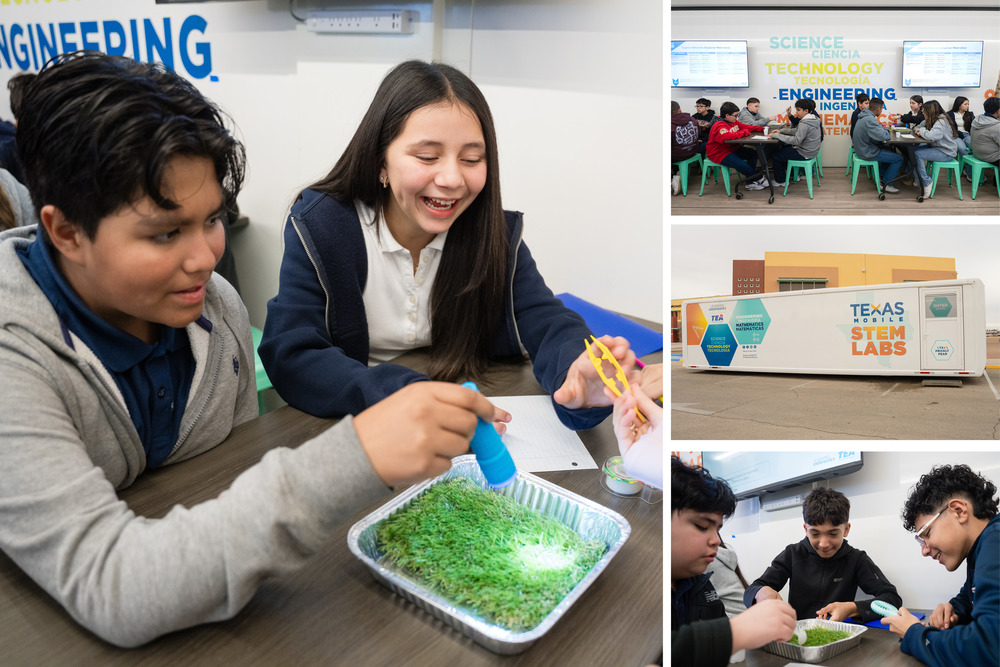
Students at Spec. Rafael Hernando III Middle School put on their engineering hats to tackle real-world challenges through hands-on STEM projects.
Eighth-grade honors science students designed a tool to remove an invasive species and restore balance to the ecosystem. Sixth graders combined vinegar and baking soda to create a fuel-efficient truck for a transportation company. Seventh graders built a sturdy bridge capable of safely delivering travelers across a river during the era of westward expansion.
All of these challenges were part of the Texas Mobile STEM Lab, a program that brings cutting-edge science, technology, engineering, and math experiences directly to students. One of nine mobile STEM labs operated by Learning Undefeated visited Hernando Middle School from Jan. 7 to 9.
Onboard the lab, students like Gabriel Spore, an eighth-grader, had 20 minutes to remove an invasive species (lettuce seeds) from the environment while protecting the native species (beads). Spore rolled a string over a piece of artificial turf to pop out the seeds while one of his teammates used a spoon to dig them out, and another teammate operated a handheld fan, hoping the air would sweep the seeds away.
“It’s not really working,” Spore said with a laugh. "It’s kind of a struggle cause they’re really deep in there.”
The Texas Mobile STEM Labs serve all 20 Texas Education Regions, reaching 270 schools each year. The Socorro Independent School District was one of four districts in Region 19 selected to host the lab during the 2025-26 school year.
Learning Undefeated’s Engineering Design Curriculum, supported by the Texas Education Agency (TEA), is offered on the mobile labs and features sixteen 60-minute activities. Each activity focuses on defining a problem, identifying criteria and constraints, designing, building, testing, and evaluating through iteration.
Marcos Lares, the lab’s educational coordinator, said the lab provides career and skills training to inspire children to pursue STEM careers. Through the day’s activity, students not only learned why a balanced ecosystem mattered, but they also used the engineering design process to remove an invasive species.
“We don't always succeed, but they always improve, right? And we always encourage them to improve, to go beyond. And even when they're challenged, they're encouraged to move forward,” Lares said.
Aniston Acero’s team used tape and tweezers to successfully remove 17 lettuce seeds, the highest number of any team, from their ecosystem.
Part of their success was that all four team members contributed ideas that they experimented with.
“I think it's cool that they brought (the lab) to us, and I feel like they see potential in everybody in the school, “Acero said.